
Choosing a mobility scooter involves more than finding a model that feels comfortable during a short test drive. The scooter also needs to suit your physical abilities, daily journeys, home environment, transport arrangements and long-term mobility needs.
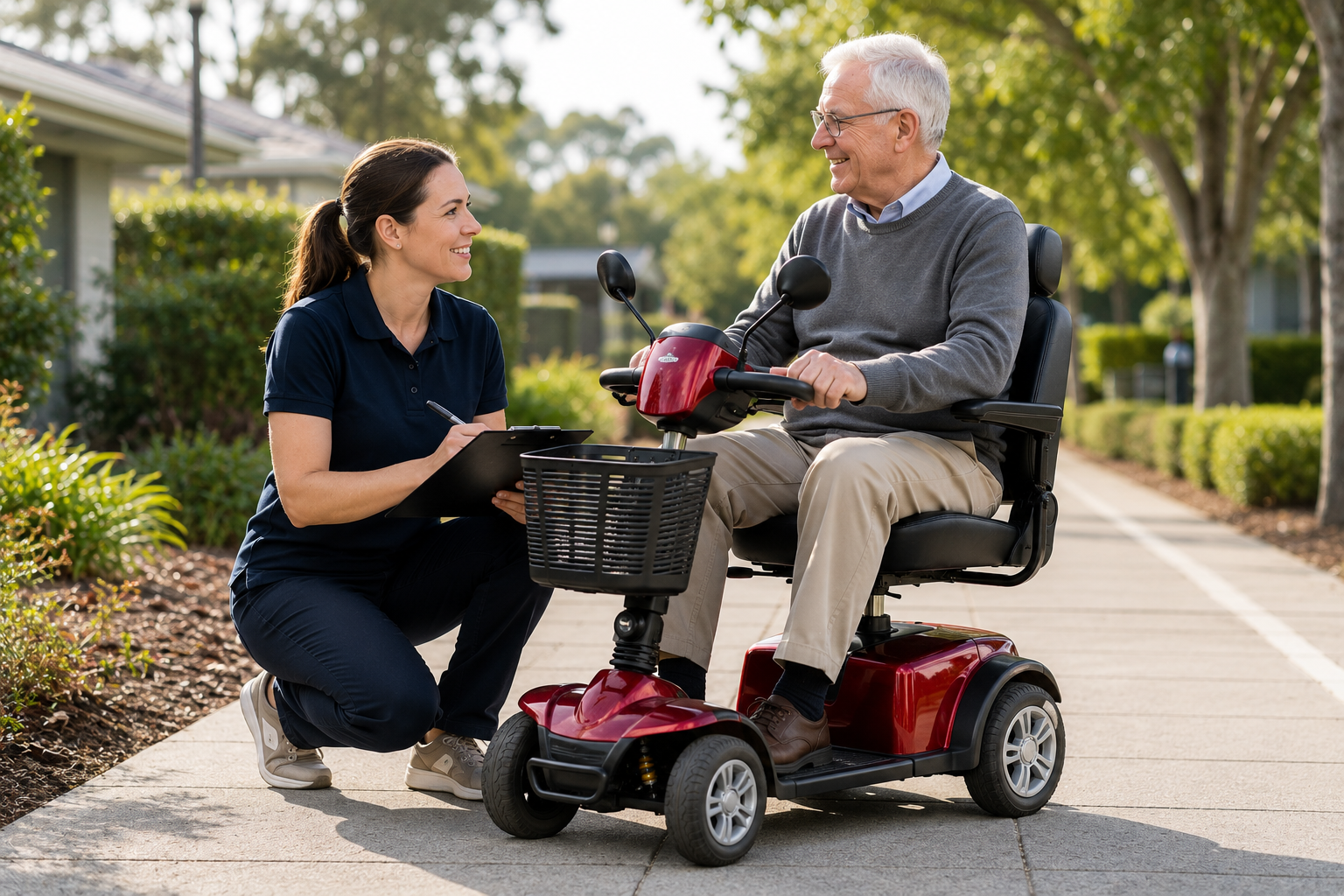
An occupational therapy mobility scooter assessment can help identify the scooter size and features that are most likely to support safe, practical and independent community access.
Is a Mobility Scooter the Right Option?
A mobility scooter may be suitable for someone who can walk short distances but finds longer journeys difficult because of pain, fatigue, reduced endurance, disability or another health condition.
It may help with accessing shops, attending appointments, visiting family or participating in community activities.
However, a scooter will not be appropriate for everyone. Safe use requires sufficient physical, visual and cognitive abilities, together with suitable access, storage and charging arrangements.
An occupational therapist can help determine whether a scooter or another mobility option would be most appropriate.
10 Things to Consider When Choosing a Mobility Scooter
1. Where Will You Use It?
Begin by considering the journeys you want to complete.
A scooter intended for use inside a shopping centre may need different features from one used on uneven outdoor paths or for longer community journeys.
Consider:
Typical travel distances
Footpath surfaces
Slopes and kerbs
Road crossings
Traffic
Indoor manoeuvring
Weather exposure
Access to regular destinations
2. Which Scooter Size Is Appropriate?
Mobility scooters are available in portable, medium-sized and larger configurations.
Portable scooters may be easier to transport but can provide less stability, postural support and battery range. Larger scooters may perform better outdoors but require more room for access, turning and storage.
The most appropriate size depends on your abilities, environment, transport arrangements and intended use.
3. Is the Seat Supportive and Comfortable?
Seat width, depth, height and back support can affect comfort, posture and your ability to use the scooter safely.
Check whether:
Your feet are supported
You can comfortably reach the controls
Your posture feels stable
The armrests provide appropriate support
You can sit comfortably for the expected journey
You can safely transfer on and off
Comfort during a brief trial does not necessarily demonstrate that a seat will remain appropriate during longer journeys.
4. Can You Operate the Controls Safely?
Operating a scooter requires steering, acceleration, braking and the ability to respond appropriately to unexpected situations.
Consider whether pain, weakness, reduced coordination or limited hand function affects your ability to use the controls.
Alternative control arrangements may be available on some models, but these need to be assessed carefully.
5. Can You Recognise and Respond to Hazards?
Safe scooter use involves noticing and responding to pedestrians, vehicles, driveways, changing surfaces, slopes, crossings and other hazards.
Vision, attention, judgement, reaction time and memory may all affect scooter safety. An occupational therapist may assess these areas as part of a comprehensive mobility scooter assessment.
6. Will the Scooter Fit at Home?
Measure more than the space where the scooter will be parked.
Consider:
Gates and doorways
Corridors
Turning space
Ramps and thresholds
Driveway gradients
Access to a power point
Safe charging
Protection from weather
Whether the scooter obstructs an exit or access route
A home assessment can identify potential difficulties before a scooter is purchased.
7. How Will You Transport It?
If the scooter needs to travel in a car, consider its weight, dimensions and whether it can be safely dismantled, folded or lifted.
You may also need to consider:
Vehicle boot dimensions
Weight of individual components
Who will lift the scooter
Risk of injury when loading it
Whether a hoist or vehicle modification is required
Whether the scooter can be safely secured
A scooter described as portable may still be too heavy or awkward for the intended person to transport safely.
8. Is the Battery Range Sufficient?
Advertised battery ranges are estimates and can be affected by hills, surfaces, user weight, battery condition, temperature and how the scooter is operated.
Consider the distance of a return journey and allow a safety margin. You should also have a clear plan for regular charging and know what to do if the battery becomes low away from home.
9. Can It Manage Local Terrain?
A scooter should be trialled under conditions relevant to its intended use whenever possible.
Consider:
Steep paths
Uneven or damaged footpaths
Gravel
Grass
Kerbs
Crossings
Tight spaces
Wet surfaces
A scooter that performs well on a smooth showroom floor may behave differently in the community.
10. What Training or Support Is Required?
Even experienced drivers may benefit from training when changing to a different scooter.
Training may cover:
Starting and stopping
Steering and reversing
Speed selection
Negotiating slopes
Managing kerbs and crossings
Using mirrors, lights and indicators
Charging and battery care
Weather and visibility
Emergency planning
Family members or support workers may also need guidance about safe assistance, transport or charging.
Why Trial a Mobility Scooter Before Buying It?
A trial allows you to test whether the scooter is comfortable, accessible and manageable before committing to it.
During a trial, an occupational therapist may consider:
Seating and posture
Access to controls
Steering and braking
Turning circle
Stability
Transfers
Indoor and outdoor access
Community safety
Storage
Transport
Battery requirements
More than one model may need to be considered. The most expensive or powerful scooter is not automatically the safest or most suitable choice.
Should the Scooter Be Trialled at Home?
Where possible, it can be valuable to trial a scooter in the environment where it will be used.
This allows the scooter to be tested against actual doorways, gates, ramps, storage areas, driveways, footpaths and community routes.
A home and community assessment can identify practical problems that may not be apparent during a supplier showroom trial.
When Is an Occupational Therapy Assessment Recommended?
An occupational therapy assessment may be particularly helpful when:
The scooter is being requested through a funding body
There are physical, visual or cognitive safety concerns
The person has complex health or disability-related needs
The scooter will be used on challenging terrain
Several scooter types are being considered
Home access or storage is uncertain
Vehicle transport is required
The current scooter is no longer suitable
Training or supervision may be needed
The occupational therapist can assess the person, their environment and the proposed equipment together.
Does an Assessment Guarantee Funding?
No. An occupational therapy assessment provides clinical evidence about the person’s needs, scooter trials and the recommended equipment.
The relevant funding organisation makes the final decision according to its eligibility and funding rules.
For NDIS participants, the evidence required may depend on the scooter’s cost and risk. Participants should confirm current requirements with their NDIS contact, plan manager or support coordinator.
Mobility Scooter Assessments in Adelaide
Thrive Health Therapies provides occupational therapy mobility scooter assessments in homes and community environments across metropolitan Adelaide.
Our occupational therapists can assess your mobility and safety, collaborate with equipment suppliers, help coordinate scooter trials and provide written recommendations or funding evidence where required.
Learn more about our mobility scooter assessments in Adelaide
You can also contact our team on 0474 248 081 or enquiries@thrivehealththerapies.com.